Vladimir Putin has claimed he has information that the United States is planning a fresh wave of airstrikes in Syria.
The Russian president said Moscow had also received intelligence about planned fake chemical weapons attacks with the sole purpose of pinning the blame on Bashar al Assad's regime.
Russia has rejected suggestions from the outset that the Syrian government was behind a gas attack in Idlib province which killed more than 80 people, including many children.
The US retaliated with airstrikes on a Syrian airbase from which it believes the chemical attack in the rebel-held town of Khan Sheikhoun was launched.
Both the Syrian regime and Russia have denied they were involved.
Mr Putin appealed to the United Nations to launch an official investigation into the attack.
He compared the allegation levelled at Mr Assad to how the US justified its intervention in Iraq in 2003.
Claims that Saddam Hussein's regime had weapons of mass destruction were never proven.
His comments came as Turkey confirmed sarin gas was used in the attack in northern Syria - and US Secretary of State Rex Tillerson arrived in Moscow for crucial talks on "a solution which will deliver a lasting political settlement" in Syria.
G7 foreign ministers earlier rejected British Foreign Secretary Boris Johnson's calls to broaden sanctions against Russia and Syria.
Italian foreign minister Angelino Alfano said Russia must not be "pushed into a corner" over Syria.


Tuesday, April 11, 2017
Jared Kushner, Man of Steel
Why don’t we just stitch him a red cape, put him in spandex, affix a stylized “S” to his chest and be done with it?
SuperJared has taken flight.
He’s President Trump’s point man with the Chinese, having finalized the details of the big meeting at Mar-a-Loco later this week. He was Trump’s middleman with the Mexicans not long ago.
“A shadow secretary of state,” The Washington Post calledJared Kushner, and that was well before he traveled to Iraq on Monday, beating the actual secretary of state, Rex Tillerson, to one of the most consequential theaters of American foreign policy.
Kushner’s to-do list, not Tillerson’s, contains the small, pesky item of brokering a durable truce between the Israelis and the Palestinians. “If you can’t produce peace in the Middle East, nobody can,” Trump said to the 36-year-old real estate scion, who has absolutely no background in diplomacy, from the stage of an inaugural party.
The precise strategy is under wraps. As Henry Kissinger, an informal adviser to Kushner and others in the Trump administration, told Annie Karni of Politico in mid-February: “It’s not clear to me in what way he’s in charge of it, whether he’s in charge of it with supervision from the White House, or whether he’s supposed to be the actual negotiator. Nor has it been defined what they’re negotiating about.”
Mere details! Just leave things to Kushner. He’ll figure it out in those down moments when he’s not supervising the brand new Office of American Innovation, whose modest ambition is a full-scale reorganization of the federal government that makes it more efficient.
His plan on that front is clear. He’ll simply do everything himself. Take note: When you file your taxes in about two weeks, you can send them either to the Internal Revenue Service or to Kushner. He’ll be chipping in with the auditing.
Sign Up for the Opinion Today Newsletter
Every weekday, get thought-provoking commentary from Op-Ed columnists, the Times editorial board and contributing writers from around the world.
I jest, and I do so in line with the mocking tone of the media’s continuing tally of tasks being piled on Kushner’s plate. But Kushner’s many mandates aren’t a laughing matter. They’re a reflection of some of Trump’s most unsettling traits as president, and Kushner is a symbol of his delusions.
Trump keeps expanding Kushner’s bloated portfolio while leaving key agencies woefully understaffed, and that’s “a sign that he doesn’t know how government works,” said a former Bush administration official who has had extensive dealings with Kushner.
“There’s no deputy secretary of state,” the official told me. “There’s no deputy secretary of defense.” He ticked off an array of other unfilled positions, insisted that these gaps can’t all be chalked up to some noble desire to shrink government and said that they pretty much prevent any meaningful follow-through on whatever bold ideas Kushner might hatch. “Trump just thinks, ‘Oh, yeah, Jared’s in charge of that.’ In charge of what? What’s he running? You need a bureaucratic infrastructure.”
Trump’s overreliance on Kushner illustrates the extraordinary premium he places on loyalty. Kushner’s status as a visionary is entirely disputable: His real-estate company was a birthright, not a start-up, and as an article by Charles Bagli in The Times this week demonstrated, one of Kushner’s key acquisitions, the skyscraper at 666 Fifth Avenue, turned into an albatross. But he married Ivanka. He’s family. And he chose the political ambitions of his father-in-law over his own previous reputation as a reasonably enlightened man.
Kushner also exemplifies the degree to which Trump not only prizes the fresh eyes of people from outside of politics, which is sensible, but downright fetishizes them, which isn’t. To the extent that the administration is staffed, it teems with government naïfs, and that has been apparent in the botched composition and rollout of executive orders and in the failed attempt to undo Obamacare.
Trump’s cavalier attitude toward conflicts of interest is manifest in Kushner, who was reportedly talking about government business with the Chinese ambassador even as his family’s company sought Chinese investment for that skyscraper.
So is Trump’s magical thinking. The president seems to see certain people as exempt from the laws of gravity, and he has accorded Kushner a place snug beside him in that pantheon. He keeps telling us that he can predict the future, and he keeps telling himself that Kushner can juggle more than even the most seasoned, brilliant White House aides of yesteryear pulled off. Kushner doesn’t seem to be quibbling.
I’m told by insiders that when Trump’s long-shot campaign led to victory, he and Kushner became convinced not only that they’d tapped into something that everybody was missing about America, but that they’d tapped into something that everybody was missing about the two of them.
Kushner was reborn with new powers, and to the heavens he ascended.
It’s a bird! It’s a plane!
It’s ridiculous.
SuperJared has taken flight.
He’s President Trump’s point man with the Chinese, having finalized the details of the big meeting at Mar-a-Loco later this week. He was Trump’s middleman with the Mexicans not long ago.
“A shadow secretary of state,” The Washington Post calledJared Kushner, and that was well before he traveled to Iraq on Monday, beating the actual secretary of state, Rex Tillerson, to one of the most consequential theaters of American foreign policy.
Kushner’s to-do list, not Tillerson’s, contains the small, pesky item of brokering a durable truce between the Israelis and the Palestinians. “If you can’t produce peace in the Middle East, nobody can,” Trump said to the 36-year-old real estate scion, who has absolutely no background in diplomacy, from the stage of an inaugural party.
The precise strategy is under wraps. As Henry Kissinger, an informal adviser to Kushner and others in the Trump administration, told Annie Karni of Politico in mid-February: “It’s not clear to me in what way he’s in charge of it, whether he’s in charge of it with supervision from the White House, or whether he’s supposed to be the actual negotiator. Nor has it been defined what they’re negotiating about.”
Mere details! Just leave things to Kushner. He’ll figure it out in those down moments when he’s not supervising the brand new Office of American Innovation, whose modest ambition is a full-scale reorganization of the federal government that makes it more efficient.
His plan on that front is clear. He’ll simply do everything himself. Take note: When you file your taxes in about two weeks, you can send them either to the Internal Revenue Service or to Kushner. He’ll be chipping in with the auditing.
Sign Up for the Opinion Today Newsletter
Every weekday, get thought-provoking commentary from Op-Ed columnists, the Times editorial board and contributing writers from around the world.
I jest, and I do so in line with the mocking tone of the media’s continuing tally of tasks being piled on Kushner’s plate. But Kushner’s many mandates aren’t a laughing matter. They’re a reflection of some of Trump’s most unsettling traits as president, and Kushner is a symbol of his delusions.
Trump keeps expanding Kushner’s bloated portfolio while leaving key agencies woefully understaffed, and that’s “a sign that he doesn’t know how government works,” said a former Bush administration official who has had extensive dealings with Kushner.
“There’s no deputy secretary of state,” the official told me. “There’s no deputy secretary of defense.” He ticked off an array of other unfilled positions, insisted that these gaps can’t all be chalked up to some noble desire to shrink government and said that they pretty much prevent any meaningful follow-through on whatever bold ideas Kushner might hatch. “Trump just thinks, ‘Oh, yeah, Jared’s in charge of that.’ In charge of what? What’s he running? You need a bureaucratic infrastructure.”
Trump’s overreliance on Kushner illustrates the extraordinary premium he places on loyalty. Kushner’s status as a visionary is entirely disputable: His real-estate company was a birthright, not a start-up, and as an article by Charles Bagli in The Times this week demonstrated, one of Kushner’s key acquisitions, the skyscraper at 666 Fifth Avenue, turned into an albatross. But he married Ivanka. He’s family. And he chose the political ambitions of his father-in-law over his own previous reputation as a reasonably enlightened man.
Kushner also exemplifies the degree to which Trump not only prizes the fresh eyes of people from outside of politics, which is sensible, but downright fetishizes them, which isn’t. To the extent that the administration is staffed, it teems with government naïfs, and that has been apparent in the botched composition and rollout of executive orders and in the failed attempt to undo Obamacare.
Trump’s cavalier attitude toward conflicts of interest is manifest in Kushner, who was reportedly talking about government business with the Chinese ambassador even as his family’s company sought Chinese investment for that skyscraper.
So is Trump’s magical thinking. The president seems to see certain people as exempt from the laws of gravity, and he has accorded Kushner a place snug beside him in that pantheon. He keeps telling us that he can predict the future, and he keeps telling himself that Kushner can juggle more than even the most seasoned, brilliant White House aides of yesteryear pulled off. Kushner doesn’t seem to be quibbling.
I’m told by insiders that when Trump’s long-shot campaign led to victory, he and Kushner became convinced not only that they’d tapped into something that everybody was missing about America, but that they’d tapped into something that everybody was missing about the two of them.
Kushner was reborn with new powers, and to the heavens he ascended.
It’s a bird! It’s a plane!
It’s ridiculous.
Russia says US ties are 'worst since Cold War' ahead of Tillerson visit
Russia's foreign ministry has said the country's relations with the US are the most difficult since the end of the Cold War.
It comes ahead of a visit by US Secretary of State Rex Tillerson to Moscow - and after G7 foreign ministers rejected UK Foreign Secretary Boris Johnson's calls to broaden sanctions against Russia and Syria.
Pressure has been mounting on Russia to end its support for Syrian leader Bashar al Assad following the US missile attack on a Syrian airbase, carried out in retaliation for a chemical weapons attack blamed on the president's regime - something it denies.
However, at a news conference at the close of the summit, Italian foreign minister Angelino Alfano said Russia must not be "pushed into a corner" over Syria.
Mr Tillerson, who is heading to Moscow to work on "a solution which will deliver a lasting political settlement" in Syria, has raised fresh expectations of aggressive military action against the country and any other repressive regimes.
Speaking in a tougher tone than his Italian counterpart, he said Russia had a choice - to align itself with the US and like-minded nations, or with Mr Assad, Iran and the militant group Hezbollah.
Mr Tillerson said it was unclear whether Russia had failed to take its obligations in Syria seriously, or whether it was was incompetent, but he said the distinction "doesn't much matter to the dead".
He said another chemical weapons attack could not be allowed to happen, adding: "It is clear to us the reign of the Assad family is coming to an end."
Mr Johnson had seen the G7 summit as a game-changing moment and had called for new sanctions to be imposed on Syrian military figures and Russian military individuals responsible for backing them.
But the question of added sanctions had barely been mentioned in the meetings, according to French foreign minister Jean-Marc Ayrault.
The outcome has fallen well short of that, with the countries agreeing there could be no Syrian peace deal with Mr Assad in power.
However, it was unclear how the group of seven nations expected Mr Assad's departure to be brought about.
It comes ahead of a visit by US Secretary of State Rex Tillerson to Moscow - and after G7 foreign ministers rejected UK Foreign Secretary Boris Johnson's calls to broaden sanctions against Russia and Syria.
Pressure has been mounting on Russia to end its support for Syrian leader Bashar al Assad following the US missile attack on a Syrian airbase, carried out in retaliation for a chemical weapons attack blamed on the president's regime - something it denies.
However, at a news conference at the close of the summit, Italian foreign minister Angelino Alfano said Russia must not be "pushed into a corner" over Syria.
Mr Tillerson, who is heading to Moscow to work on "a solution which will deliver a lasting political settlement" in Syria, has raised fresh expectations of aggressive military action against the country and any other repressive regimes.
Speaking in a tougher tone than his Italian counterpart, he said Russia had a choice - to align itself with the US and like-minded nations, or with Mr Assad, Iran and the militant group Hezbollah.
Mr Tillerson said it was unclear whether Russia had failed to take its obligations in Syria seriously, or whether it was was incompetent, but he said the distinction "doesn't much matter to the dead".
He said another chemical weapons attack could not be allowed to happen, adding: "It is clear to us the reign of the Assad family is coming to an end."
Mr Johnson had seen the G7 summit as a game-changing moment and had called for new sanctions to be imposed on Syrian military figures and Russian military individuals responsible for backing them.
But the question of added sanctions had barely been mentioned in the meetings, according to French foreign minister Jean-Marc Ayrault.
The outcome has fallen well short of that, with the countries agreeing there could be no Syrian peace deal with Mr Assad in power.
However, it was unclear how the group of seven nations expected Mr Assad's departure to be brought about.
Stockholm truck attack suspect 'confesses to terrorist crime'
The Stockholm truck attack suspect has admitted committing a terrorist crime, his lawyer has said.
He told a court that Rakhmat Akilov, 39, had confessed to deliberately driving the stolen beer lorry into crowds along Drottninggatan in the Swedish capital.
Four people were killed and another 15 injured in the attack on 7 April.
Johan Eriksson, defending Akilov, said "His position is that he admits to a terrorist crime and accepts therefore that he will be detained."
The rest of the court hearing was held behind closed doors, with the suspect having entered the court with a green sweater over his head.
The arrest warrant of a second suspect held over the attack has been revoked, prosecutors said on Tuesday.
He will not be released due to an earlier decision that he should be expelled from Sweden.
On Monday, Akilov's request for his state-appointed lawyer to be replaced with a Sunni Muslim was denied.
He told a court that Rakhmat Akilov, 39, had confessed to deliberately driving the stolen beer lorry into crowds along Drottninggatan in the Swedish capital.
Four people were killed and another 15 injured in the attack on 7 April.
Johan Eriksson, defending Akilov, said "His position is that he admits to a terrorist crime and accepts therefore that he will be detained."
The rest of the court hearing was held behind closed doors, with the suspect having entered the court with a green sweater over his head.
The arrest warrant of a second suspect held over the attack has been revoked, prosecutors said on Tuesday.
He will not be released due to an earlier decision that he should be expelled from Sweden.
On Monday, Akilov's request for his state-appointed lawyer to be replaced with a Sunni Muslim was denied.
Anger as 539 council bosses paid more than PM Theresa May
At least 2,300 council employees in England and Wales are earning six-figure salaries, according to research from the TaxPayers' Alliance.
The group, which campaigns for smaller government and lower taxes, claims the number of public sector workers being paid in excess of £100,000 a year is increasing.
It said 539 of these employees received packages worth more than £150,000 in 2015/16 - more than Prime Minister Theresa May.
That group saw an increase of 53 compared to the previous year.
John O'Connell, chief executive of the TaxPayers' Alliance, said the high pay levels are "disappointing" given council tax bills are increasing and local services are being cut.
"Despite many in the public sector facing a much-needed pay freeze to help bring the public finances under control, many town hall bosses are continuing to pocket huge remuneration packages, with the number of people on six-figure deals actually going up since last year," he said.
"There are talented people in the public sector who are trying to deliver more for less, but the sheer scale of these packages raises serious questions about efficiency and priorities."
Southwark Council in London was the local authority which had the most employees on six-figure salaries - with 44 staff taking home more than £100,000 a year.
The figures also reveal Dave Smith, the former chief executive of Sunderland City Council, was the local government employee with the largest total pay package in 2015/16.
He received £625,570 - including a pay-off worth £185,470 and pension contributions of £331,414.
The TaxPayers' Alliance warned its figure of 2,314 six-figure earners was "likely to be an understatement" because councils present their remuneration data inconsistently.
Councillor Claire Kober, who chairs the Local Government Association's resources board, said councils are "committed to providing value for money to taxpayers" - and incoming chief executives are being paid considerably less than their predecessors.
But she added: "It is important that the right people with the right skills and experience are retained to deliver this work.
"The pay of senior council staff is set by politically proportionate committees of elected councillors and is open to a high level of scrutiny and democratic accountability as a result."
A spokesman for the Department of Communities and Local Government said: "Whilst it's a matter for individual local authorities, ministers have been clear that they expect them to show restraint from excessive pay rises, especially when it comes to senior staff.
"We've taken steps to make sure councils are more transparent on how they set pay and can be held accountable by local residents."
The group, which campaigns for smaller government and lower taxes, claims the number of public sector workers being paid in excess of £100,000 a year is increasing.
It said 539 of these employees received packages worth more than £150,000 in 2015/16 - more than Prime Minister Theresa May.
That group saw an increase of 53 compared to the previous year.
John O'Connell, chief executive of the TaxPayers' Alliance, said the high pay levels are "disappointing" given council tax bills are increasing and local services are being cut.
"Despite many in the public sector facing a much-needed pay freeze to help bring the public finances under control, many town hall bosses are continuing to pocket huge remuneration packages, with the number of people on six-figure deals actually going up since last year," he said.
"There are talented people in the public sector who are trying to deliver more for less, but the sheer scale of these packages raises serious questions about efficiency and priorities."
Southwark Council in London was the local authority which had the most employees on six-figure salaries - with 44 staff taking home more than £100,000 a year.
The figures also reveal Dave Smith, the former chief executive of Sunderland City Council, was the local government employee with the largest total pay package in 2015/16.
He received £625,570 - including a pay-off worth £185,470 and pension contributions of £331,414.
The TaxPayers' Alliance warned its figure of 2,314 six-figure earners was "likely to be an understatement" because councils present their remuneration data inconsistently.
Councillor Claire Kober, who chairs the Local Government Association's resources board, said councils are "committed to providing value for money to taxpayers" - and incoming chief executives are being paid considerably less than their predecessors.
But she added: "It is important that the right people with the right skills and experience are retained to deliver this work.
"The pay of senior council staff is set by politically proportionate committees of elected councillors and is open to a high level of scrutiny and democratic accountability as a result."
A spokesman for the Department of Communities and Local Government said: "Whilst it's a matter for individual local authorities, ministers have been clear that they expect them to show restraint from excessive pay rises, especially when it comes to senior staff.
"We've taken steps to make sure councils are more transparent on how they set pay and can be held accountable by local residents."
Death penalty: Global executions fall 37% since 2015 - Amnesty
The number of executions recorded worldwide in 2016 fell by 37% on the previous year, human rights group Amnesty International says.
At least 1,032 people were executed last year, down from 1,634 in 2015, Amnesty said.
The fall was largely driven by fewer deaths recorded in Iran and Pakistan.
China is believed to have executed more than all countries combined but has not been included in the figures given the lack of reliable data, the group adds.
The US was removed from the top five for the first time since 2006, according to Amnesty.
Despite fewer executions, Iran and Pakistan remain in Amnesty's top five list, along with China, Saudi Arabia and Iraq.
Pakistan's execution rate dropped from 326 recorded deaths in 2015 to at least 87 the following year.
The high number reported in 2015 followed the lifting of a seven-year moratorium on executions in December 2014 in response to a deadly Taliban attack on a school in Peshawar.
The country then created military courts to try civilians suspected of terrorism-related offences.
In 2016, at least four of those executed in the country were convicted by the military courts.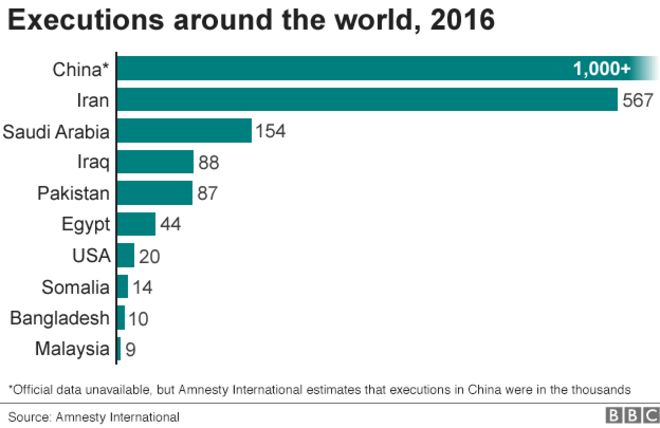
In Iran, at least 567 people were executed last year, compared with 977 in 2015. Amnesty reported a surge in executions in 2015 but said the reasons were unclear. The majority of those killed, the group said, were convicted of drug charges.
The 2016 figure makes up 55% of the annual total, according to Amnesty.
Of those put to death in Iran, the group found, at least two people were under 18 at the time of the crime for which they had been convicted. This, it said, violated international law.
The US recorded the lowest number of executions since 1991. But, Amnesty said, there was a "shocking number of executions" scheduled in the state of Arkansas this year, adding that this was an example of "how quickly the picture can change".
Despite the significant decrease in recorded executions worldwide in 2016, the total remained higher than the average recorded for the previous decade.
Amnesty said that China remained the world's top executioner but said that secrecy around the death penalty made it difficult to confirm the figures.
The group reported that an investigation found that information relating to "hundreds" of death penalty cases was missing from the country's national database.
Meanwhile, Belarus and authorities within the Palestinian territories resumed executions in 2016 after a year's hiatus, while Botswana and Nigeria carried out their first executions since 2013.
What's behind Pakistan's rise in executions?
Belarus: Death penalty returns to Europe
The group also noted that:
In the Middle East and North Africa overall, the number of executions decreased by 28%
In sub-Saharan Africa, death sentences increased by 145%, largely because of a rise in Nigeria
In Europe and Central Asia, Belarus and Kazakhstan were the only two countries in the region to use the death penalty
On the other hand, 104 countries were recorded to have abolished the death penalty in law or practice. Back in 1997, that figure was 64.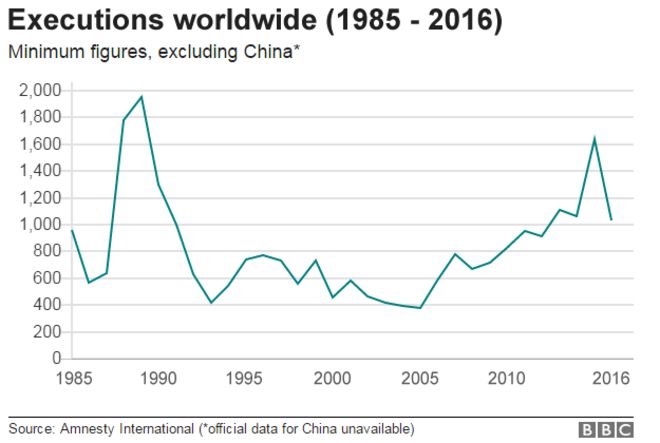
Two countries, Benin and Nauru, abolished the death penalty for all crimes in 2016, while Guinea abolished it for ordinary crimes only.
Several others took steps to restrict their use of this punishment, confirming that the global trend remained towards the abolition of the death penalty.
Amnesty recorded executions in 23 countries, two fewer than in 2015.
Commenting on Tuesday's report, human rights pressure group Reprieve said that while the overall trend towards fewer executions was welcome, it was "disturbed" by the reported increase in use of the death penalty by certain governments, including Saudi Arabia and Bahrain.
Amnesty collects its statistics using official figures, media reports and information passed on from individuals sentenced to death and their families and representatives.
At least 1,032 people were executed last year, down from 1,634 in 2015, Amnesty said.
The fall was largely driven by fewer deaths recorded in Iran and Pakistan.
China is believed to have executed more than all countries combined but has not been included in the figures given the lack of reliable data, the group adds.
The US was removed from the top five for the first time since 2006, according to Amnesty.
Despite fewer executions, Iran and Pakistan remain in Amnesty's top five list, along with China, Saudi Arabia and Iraq.
Pakistan's execution rate dropped from 326 recorded deaths in 2015 to at least 87 the following year.
The high number reported in 2015 followed the lifting of a seven-year moratorium on executions in December 2014 in response to a deadly Taliban attack on a school in Peshawar.
The country then created military courts to try civilians suspected of terrorism-related offences.
In 2016, at least four of those executed in the country were convicted by the military courts.
In Iran, at least 567 people were executed last year, compared with 977 in 2015. Amnesty reported a surge in executions in 2015 but said the reasons were unclear. The majority of those killed, the group said, were convicted of drug charges.
The 2016 figure makes up 55% of the annual total, according to Amnesty.
Of those put to death in Iran, the group found, at least two people were under 18 at the time of the crime for which they had been convicted. This, it said, violated international law.
The US recorded the lowest number of executions since 1991. But, Amnesty said, there was a "shocking number of executions" scheduled in the state of Arkansas this year, adding that this was an example of "how quickly the picture can change".
Despite the significant decrease in recorded executions worldwide in 2016, the total remained higher than the average recorded for the previous decade.
Amnesty said that China remained the world's top executioner but said that secrecy around the death penalty made it difficult to confirm the figures.
The group reported that an investigation found that information relating to "hundreds" of death penalty cases was missing from the country's national database.
Meanwhile, Belarus and authorities within the Palestinian territories resumed executions in 2016 after a year's hiatus, while Botswana and Nigeria carried out their first executions since 2013.
What's behind Pakistan's rise in executions?
Belarus: Death penalty returns to Europe
The group also noted that:
In the Middle East and North Africa overall, the number of executions decreased by 28%
In sub-Saharan Africa, death sentences increased by 145%, largely because of a rise in Nigeria
In Europe and Central Asia, Belarus and Kazakhstan were the only two countries in the region to use the death penalty
On the other hand, 104 countries were recorded to have abolished the death penalty in law or practice. Back in 1997, that figure was 64.
Two countries, Benin and Nauru, abolished the death penalty for all crimes in 2016, while Guinea abolished it for ordinary crimes only.
Several others took steps to restrict their use of this punishment, confirming that the global trend remained towards the abolition of the death penalty.
Amnesty recorded executions in 23 countries, two fewer than in 2015.
Commenting on Tuesday's report, human rights pressure group Reprieve said that while the overall trend towards fewer executions was welcome, it was "disturbed" by the reported increase in use of the death penalty by certain governments, including Saudi Arabia and Bahrain.
Amnesty collects its statistics using official figures, media reports and information passed on from individuals sentenced to death and their families and representatives.
Malala Yousafzai Youngest ever UN Messenger of Peace.
Nobel Peace Prize winner Malala Yousafzai has been made the youngest ever UN Messenger of Peace.
The 19-year-old, who is doing her A-levels and has an offer from a top UK university, will take the role with a special focus on girls' education.
In 2012 Ms Yousafzai was nearly killed by the Taliban for campaigning for girls' rights to education.
Accepting the accolade in New York, she said: "(Bringing change) starts with us and it should start now."
"If you want to see your future bright, you have to start working now (and) not wait for anyone else," he said.
United Nations secretary-general Antonio Guterres described her as a "symbol of perhaps the most important thing in the world - education for all".
Last month, Ms Yousafzai said she had received an offer to study politics, philosophy and economics at a UK university, on condition of achieving three As in her A-levels.
Ms Yousafzai, who narrowly escaped death after being attacked on her way home from school in Pakistan, did not confirm which university had made the offer.
But previously she revealed she had interviewed for a degree place at an Oxford college.
UN Messengers of Peace are selected from the fields of art, literature, science, entertainment, sports or other fields of public life.
Other messengers have included Muhammad Ali, George Clooney, Michael Douglas, Leonardo DiCaprio, Stevie Wonder and Charlize Theron.
The 19-year-old, who is doing her A-levels and has an offer from a top UK university, will take the role with a special focus on girls' education.
In 2012 Ms Yousafzai was nearly killed by the Taliban for campaigning for girls' rights to education.
Accepting the accolade in New York, she said: "(Bringing change) starts with us and it should start now."
"If you want to see your future bright, you have to start working now (and) not wait for anyone else," he said.
United Nations secretary-general Antonio Guterres described her as a "symbol of perhaps the most important thing in the world - education for all".
Last month, Ms Yousafzai said she had received an offer to study politics, philosophy and economics at a UK university, on condition of achieving three As in her A-levels.
Ms Yousafzai, who narrowly escaped death after being attacked on her way home from school in Pakistan, did not confirm which university had made the offer.
But previously she revealed she had interviewed for a degree place at an Oxford college.
UN Messengers of Peace are selected from the fields of art, literature, science, entertainment, sports or other fields of public life.
Other messengers have included Muhammad Ali, George Clooney, Michael Douglas, Leonardo DiCaprio, Stevie Wonder and Charlize Theron.
Subscribe to:
Comments (Atom)