Powered By Blogger

Thursday, December 3, 2015

California Massacre Suspects Dropped Off Baby

Farhan Khan brother in law of California shooting suspect Syed Rizwan Farook
Syed Rizwan Farook, 28, and Tashfeen Malik, 27, told Farook's mother they were going to a doctor's appointment after leaving their child on Wednesday.
Hours later they were shot dead following a police chase.
Farook, who was born in the US, worked as an environmental health specialist for San Bernardino County, inspecting restaurants for health violations and public pools at apartment and housing complexes.
On Wednesday, he attended the annual holiday gathering for employees of his department, but left after an apparent dispute, returning later with Malik dressed in assault clothing and armed with legally purchased long rifles.
San Bernardino Police Chief Jarrod Burguan said that the shooting spree had been clearly planned in advance and that the suspects left several explosive devices, apparently pipe bombs, at the scene of the shootings.
Officials with the Council on American-Islamic Relations (CAIR), who have been in touch with the family, said the couple were married two years ago and have a six-month-old baby girl.
They left the baby with Farook's mother in nearby Redlands on Wednesday.
At a CAIR news conference, Farook's brother-in-law Farhan Kahn said he was "shocked" by the news.
He said: "I'm very sad that people lost their life and there are victims out there. I am in shock that something like this could happen.
"I spoke to him about a week ago. I have no idea why would he do that, why would he do something like this."
Mr Burguan said officers went to a house in Redlands and saw the couple leave in a black SUV. Police then pursued that vehicle to San Bernardino, where they were fatally injured in a gun battle.
Farook's family was originally from South Asia, while Malik was believed to be from Pakistan and to have lived in Saudi Arabia before coming to the US, according to CAIR Los Angeles chapter executive director Hussam Ayloush.
He said that Farook had an older brother, who had served in the US military.
David Bowdich, an assistant regional FBI director, said on Wednesday that authorities had not ruled out terrorism.
He said: "It is a possibility, but we don't know that. It's possible it goes down that road. It's possible it does not."

Obama calls for gun reforms in wake of San Bernardino shooting

President Barack Obama reiterated his call for more gun control reforms to make mass shootings in the U.S. "rare as opposed to normal" in the wake of a mass shooting in San Bernardino, California.
Speaking to CBS News moments after news broke of the shooting, Obama called for "common sense gun safety laws" and urged lawmakers to pass a law to prevent individuals on the "No Fly List" who are barred from boarding commercial flights from legally purchasing firearms.
"We don't yet know what the motives of the shooters are but what we do know is that there are steps we can take to make Americans safer," Obama said in the interview. "We should never think that this is just something that just happens in the ordinary course of events because it doesn't happen with the same frequency in other countries."
Obama said the pattern of U.S. mass shootings "has no parallel anywhere else in the world."

Four men arrested in Luton on suspicion of terrorism offences

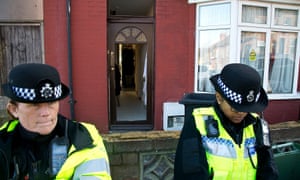
Police outside the house they searched in Luton.
Detectives have arrested four men on suspicion that they may have committed offences under terrorism laws. 
The arrests were made in Luton, Bedfordshire, and come at a time of heightened alert in Britain over fears of jihadi activity, such as attack planning and recruitment.
In a statement, Scotland Yard said: “Four men have been arrested in Luton this morning (Wednesday 2 December) on suspicion of committing offences under the Terrorism Act.
“The arrests were carried out in a joint operation by the Met’s counter terrorism command (SO15) and the eastern counter terrorism and intelligence unit (ECTIU).
“The men – who are all in their 30s – have been arrested on suspicion of being involved in the commission, preparation and instigation of acts of terrorism. They have been taken into custody at a London police station.”
The operation that led to the arrests followed a “proactive” investigation by police and assistance from the security services. The arrests were pre-planned.
The raids followed a joint meeting between police and MI5, the domestic security service, at an executive liaison group. The decision to detain suspects can be made when counter-terrorism investigators believe they have enough material to stage arrests.
But some past high-profile terror arrests have been based on intelligence that turned out to be inaccurate, and have led to accusations that police and MI5 have ramped up the nature of possible plots.
After Wednesday’s arrest, police were carrying out searches at seven separate addresses in Luton. They said that a number of vehicles were also being searched. It is expected that computers and other devices such as phones will also be examined.
Police added: “Today’s activity is part of an ongoing proactive investigation concerning individuals in the Luton area. It is not connected to the recent attacks in Paris.”
The four men were due to be questioned at a London police station.
The fear of a terrorist attack being carried out by people with connections to Islamic State or inspired by Isis ideology led the Joint Terrorism Analysis Centre (JTAC) to recommend raising the terrorist threat level in August 2014 to severe, its second highest level.
The attacks in Paris last month which left 130 dead have increased anxiety among UK officials of an attack on British soil.

New Google Vision Program Can Teach Your Robot to Recognize Your Mood

Google Illustration
Michael Gottschalk—Photothek via Getty Images

Imagine a Roomba robot that not only recognizes you as you but can tell from the scowl on your face that now may not be the best time to vacuum around your feet.
That’s the scenario enabled by a new Google tool that will let developers train robots, toys, and appliances to know who you are and even figure out from your expression what mood you’re in—and react accordingly.
Google detailed the technology in a blog post on Wednesday. A test version of the Vision Application Programming Interface is now available to developers.
At its most basic, this API will let developers build software that can interact with Google cloud-based smarts in near-real-time. In theory, that Roomba-of-the-future may see you in the room, send your image to Google computers to get information about it. Or it could be trained over time by reviewing many images to know that you are you and that a smile means you’re in a good mood and that a grimace means trouble. It would also know that the big fur ball over there is a cat and not a fuzzy slipper.
With the API, developers can apply tons of machine learning smarts to home or work applications. Machine learning, once known as artificial intelligence, is when computers learn over time from data they view to recognize people, things, words—just about anything.
All of that grunt work is enabled by the massive compute power of Google or Microsoft or Amazon public clouds, which harness a huge number of shared computers around the world. With all that firepower, the data can be crunched, parsed and served up as needed. To tell your vacuum cleaner who you are and that you may be in a crappy mood, for example.
Last month Google released TensorFlow, an artificial intelligence engine that can process images and sounds so it can recognize them later. Days later, Microsoft talked upnew Project Oxford computer vision capabilities that will let computers gauge a person’s emotional state—anger, contempt, fear, disgust, happiness, sadness, surprise —from her facial expressions. (An earlier iteration could estimate a person’s age from her image.)
This technology could also be used by parents or businesses to quickly flag objectionable or inappropriate images before kids see them or to identify corporate logos to better hone searches for shoppers.
The good news is this could mean a new generation of smarter, more capable products and services. The bad news is that some of us may be creeped out by all of that stuff.

British jets carry out air raids on ISIL

Warplanes were to begin striking ISIL just hours after parliament approved Cameron's motion [File:EPA]
British fighter planes have struck suspected ISIL targets in Syria, just hours after MPs approved a motion authorising the use of military force against the group. 
A British Ministry of Defence spokesman confirmed to Al Jazeera that Tornado jets had returned to base after conducting combat missions against the group on Thursday.
Earlier, the Reuters news agency reported that four warplanes landed at RAF Akrotiri, the base used for British air strikes on fighters belonging to ISIL, or the Islamic State of Iraq and the Levant group, in Iraq.
The strikes come just hours after UK Prime Minister David Cameron successfully passed a motion authorising strikes in Syria, with 397 MPs voting in favour, and 223 voting against. 
Cameron was backed by dozens of Labour MPs who broke ranks with leader Jeremy Corbyn, who is opposed to the military intervention.
Addressing parliament on Wednesday, Cameron said high-precision, laser-guided Brimstone missiles attached to the Tornado GR4 bombers would help to make a real difference by hitting the ISIL capital of Raqqa and its oil-trading business.
France and the US are already bombing the fighters in Syria, while Russia has bombed mainly other armed groups battling the forces of Syrian President Bashar al-Assad.
Cyprus, which lies about 100km away from Syria, is the closest European Union member state to turmoil in the Middle East.

Oscar Pistorius Conviction Changed To Murder


An appeal judge said the original verdict was "flawed" and the athlete will now be re-sentenced by the original court and will almost certainly go back to jail
A murder conviction carries a much heftier sentence: a minimum of 15 years in South Africa.
Justice Leach said Pistorius must have foreseen that firing into the small toilet cubicle would have led to death - but went ahead anyway.
A picture taken on January 26, 2013 shows Olympian sprinter Oscar Pistorius posing next to his girlfriend  Reeva Steenkamp at Melrose Arch in Johannesburg
Reeva Steenkamp's mother, June, closed her eyes but remained silent as the decision was read out in the Bloemfontein court.
The athlete is currently under house arrest at his uncle's luxurious home in Pretoria after serving less than a year for killing his girlfriend on Valentine's Day 2013.
Pistorius had said he accidentally shot dead his girlfriend after believing there was an intruder in his house.
He was originally convicted of culpable homicide - akin to manslaughter - after a long-running trial under the glare of the world's media.
The prosecution appeal centred on the concept of dolus eventualis - a Latin legal phrase meaning the act was carried out by the accused knowing it would lead to death and the accused went ahead anyway.

The U.K. Launches Air Strikes Against ISIS in Syria

Britain Syria
                                              Parliamentary Recording Unit—AP                                             
(AKROTIRI, Cyprus) — British warplanes carried out airstrikes in Syria early Thursday, hours after Parliament voted to authorize air attacks against Islamic State group targets there.
Four Royal Air Force Tornados took off from a British air base in Akrotiri, Cyprus, shortly after the 397-223 vote by lawmakers in the House of Commons.
A Ministry of Defense spokesman told the AP the planes had conducted strikes in Syria, and details about their targets would be provided later Thursday,
He spoke on condition of anonymity because he was not authorized to give his name when discussing operations.
The RAF has been launching strikes against IS targets in Iraq since 2014. The decision to expand the campaign to Syria came after an emotional 10 1/2-hour debate in which Prime Minister David Cameron said that Britain must strike the militants in their heartland and not “sit back and wait for them to attack us.”
Opponents argued that Britain’s entry into Syria’s crowded airspace would make little difference, and said Cameron’s military plan was based on wishful thinking that overlooked the messy reality of the Syrian civil war.
Cameron has long wanted to target IS in Syria, but had been unsure of getting majority support in the House of Commons until now. He suffered an embarrassing defeat in 2013 when lawmakers rejected a motion backing attacks on the forces of Syrian President Bashar Assad.
The mood has changed following the Nov. 13 Paris attacks, claimed by IS, that killed 130 people. Both France and the U.S. have urged Britain to join their air campaign in Syria, and Cameron said Britain should not let its allies down.
He said Britain was already a top target for IS attacks, and airstrikes would reduce the group’s ability to plan more Paris-style carnage.
“Do we work with our allies to degrade and destroy this threat and do we go after these terrorists in their heartlands, from where they are plotting to kill British people?” he said. “Or do we sit back and wait for them to attack us?”
He said that attacking IS was not anti-Muslim but “a defense of Islam” against “women-raping, Muslim-murdering, medieval monsters.”
Cameron was backed by most members of his governing Conservative Party — which holds 330 of the 650 Commons seats — as well as members of the smaller Liberal Democrat party and others.
Labour, the main opposition, was divided. Labour leader Jeremy Corbyn — who represents the left wing of the party — spoke against what he called a “reckless and half-baked intervention.” But more than 60 Labour lawmakers, including senior party figures, voted in support of airstrikes, a move likely to make fissures between the right and the left of the party even worse.
Labour foreign affairs spokesman Hilary Benn said Britain could not “walk by on the other side of the road” when international allies were asking for help against IS “fascists.”
Britain already conducts airstrikes against IS targets in Iraq, and in August launched a drone strike that killed two British IS militants in Syria.
British officials say Royal Air Force Typhoon and Tornado fighter jets, armed with Brimstone missiles capable of hitting moving targets, would bring the campaign highly accurate firepower and help minimize civilian casualties.
President Barack Obama welcomed the British vote to join the air campaign in Syria, saying the Islamic State group “is a global threat that must be defeated by a global response.”
Critics claim British airstrikes will make little practical difference, and that ground forces will be needed to root out IS. Britain has ruled out sending troops, and critics of the government have responded with skepticism to Cameron’s claim that there are 70,000 moderate Syrian rebels on the ground.
Cameron stood by that claim Wednesday, though he conceded, “I’m not saying that the 70,000 are our ideal partners.”
Karin von Hippel, who was chief of staff to U.S. Gen. John Allen when he was the United States’ anti-ISIS envoy, said force alone would not defeat the militants — but neither would diplomacy by itself.
“The Brits have expertise and capabilities,” she said. Their involvement “brings moral authority and legitimacy to the fight.”
The British vote came as U.S. Secretary of State John Kerry said NATO members were ready to step up military efforts against the Islamic State group — and held out hope of improved cooperation between the West and Russia to end Syria’s four-year civil war.
A day after U.S. Defense Secretary Ash Carter said the United States would deploy a new special operations force to Iraq to step up the fight against the militants, Kerry said other countries could provide assistance that did not involve combat. He said the effort to expand operations would require more medical facilities, intelligence-gathering, military support structure, refueling operations, aerial defenses and other action.
The German Cabinet has approved plans to commit up to 1,200 soldiers to support the anti-IS coalition in Syria, though not in a combat role.
Despite talk of increased international cooperation, tension has soared between Russia and Turkey after the shooting down of a Russian military jet by Turkish forces last week.
On Wednesday, Russia’s deputy defense minister, Anatoly Antonov, accused Turkish president Recep Tayyip Erdogan and his family of benefiting from illegal oil trade with Islamic State militants.
Erdogan called the claim “slander” and said Turkey would not “buy oil from a terror organization.”
Russia and the United States also disagree about tactics in Syria, with Moscow backing Assad and Washington saying he must go.
But Kerry, speaking after NATO meetings in Brussels, said that if Russia’s focus on fighting IS was “genuine,” it could have a constructive role in bringing peace. He didn’t say whether the U.S. might be willing to bring Russia into its military effort against the group, as some members such as France have proposed.
The top NATO commander in Europe, U.S. Air Force Gen. Philip Breedlove, said the bulk of Russia’s air operations in Syria are still directed against moderate anti-Assad opposition forces, not Islamic State positions.
U.S. officials had hoped Russia would change its bombing focus after the Oct. 31 attack on a Russian airliner over Egypt, which killed 224 people.
Asserting that the “vast majority” of Russian sorties targeted moderate groups, Breedlove said coalition forces were “not working with or cooperating with Russia in Syria” but had devised safety routines to make it easier for both groups.
The British debate was sometimes bad-tempered as opposition lawmakers demanded Cameron apologize for remarks, reportedly made at a closed-door meeting, in which he branded opponents a “bunch of terrorist sympathizers.”
Cameron did not retract the comments but said “there’s honor in voting for, there’s honor in voting against” the motion to back airstrikes.
From the passionate speeches in the House to the anti-war protesters outside Parliament, the debate recalled Britain’s divisive 2003 decision to join the U.S.-led invasion of Iraq on what turned out to be false claims about Saddam Hussein’s alleged weapons of mass destruction. Many lawmakers came to regret supporting the war and ensuing chaos, and blamed then-Labour Prime Minister Tony Blair for lacking a plan for post-war reconstruction.
Labour leader Corbyn said that “to oppose another reckless and half-baked intervention isn’t pacifism. It’s hard-headed common sense.”
Labour’s Shabana Mahmood — one of the few Muslim lawmakers in Parliament — called IS “Nazi-esque totalitarians who are outlaws from Islam,” but said she opposed the strikes because “we cannot simply bomb the ground, we have to have a strategy to hold it as well.”
But Cameron said doing nothing was a worse option.
“The risks of inaction are greater than the risks of what I propose,” he said.
___
Lawless reported from London. Associated Press writers Danica Kirka and Gregory Katz in London, Suzan Frazer in Ankara, Deb Riechmann in Washington, Jamey Keaten in Brussels and Sinan Salaheddin in Baghdad contributed to this report.