A two-and-a-half metre high glass security barrier is to be constructed around Paris' most recognisable landmark.
The wall will replace the metal fences put in place during the Euro 2016 football tournament and is part of a plan to prevent attacks on the monument.
French tourist sites, transport systems and places of worship have been subject to increased security measures following terrorist atrocities committed in the country between January 2015 and July 2016, which claimed 238 lives.
Construction will take place later in the year and is expected to cost €20m (£17m).
Jean-Francois Martins, deputy mayor of Paris, said: "The terror threat remains high in Paris, and the most vulnerable sites, starting with the Eiffel Tower, must be the object of special security measures.
"The glass casing will prevent individuals or vehicles storming the site visited by six million people each year.
"Architects will help design the wall so that it blends in with the Seine river, which borders the tower to the north, and with the Champ de Mars park to the south."
Some councillors have been critical of the plans, warning that a wall could transform the tower into "a fortress" and might discourage tourists from visiting.
Gustave Eiffel's wrought iron masterpiece will also undergo refurbishment following Paris' formal bid to host the 2024 Olympic Games.


Thursday, February 9, 2017
Muhammadu Buhari's 'inconclusive' medical vacation
It was Ayodele Fayose, the Governor of Ekiti State, who first saideverything under the Nigerian President Muhammadu Buhari was becoming inconclusive.
That outburst - and Fayose has quite a litany of complaints against Buhari - came after Nigeria's electoral umpire declared the Bayelsa State governorship election "inconclusive" on the third day of the exercise.
It was a happy ending for Fayose: Seriake Dickson, candidate of his party, won the election a month later. Actually, there was little to worry about in the first place.
One year on, a crisis of monstrous scale and manifold consequences is brewing. Buhari is on medical vacation in the United Kingdom, and it is so far inconclusive, even indefinite.
The announcement of Buhari's latest vacation on January 19 was itself inauspicious - not because it was his third in one year, but because he had asked the National Assembly for 10 days off when he was in fact going to be away for longer.
That a "10-day vacation" began on January 19, and was to end on February 6, offered faint indication of the president's much-guarded state of health. And it was all sudden: Yemi Osinbajo, the man Buhari temporarily handed power to, abruptly ended his participation at the World Economic Forum in Davos, Switzerland.
Rumours of hsi death have spread on fake news sites, and it is very worrisome that Buhari has refused to personally assure the country of his wellness. On one occasion Garba Shehu, one of his two spokesmen, tweeted a photo of Buhari supposedly watching Channels, Nigeria's leading television station, but it all seemed a cover-up.
The president could have called that same station to address his countrymen for just a minute. In such an ethnically divided country as Nigeria, such a move is crucial for the preservation of democratic sanity. With that assurance still missing, the power grabbers are already at work.
The fears of the north
Until May 2010, it seemed inconceivable that a member of a minority ethnic group would become president.
Were that even to happen, it looked like an outright impossibility that the north - a region that typically sees the number-one seat as its birthright - would be the victim of such power transfer.
But when northerner Umaru Musa Yar'Adua, the former president, left Nigeria for Saudi Arabia in November 2009 to get treatment for pericarditis and hadn't returned by February 2010, Goodluck Jonathan, from the Ijaw ethnic group, was formally declared acting president.
With Yar'Adua's death three months later, Jonathan - a man who was chosen as Yar'Adua's running mate not for his political appeal but for his reputation of "never rocking the boat" - became president.
That outburst - and Fayose has quite a litany of complaints against Buhari - came after Nigeria's electoral umpire declared the Bayelsa State governorship election "inconclusive" on the third day of the exercise.
It was a happy ending for Fayose: Seriake Dickson, candidate of his party, won the election a month later. Actually, there was little to worry about in the first place.
One year on, a crisis of monstrous scale and manifold consequences is brewing. Buhari is on medical vacation in the United Kingdom, and it is so far inconclusive, even indefinite.
The announcement of Buhari's latest vacation on January 19 was itself inauspicious - not because it was his third in one year, but because he had asked the National Assembly for 10 days off when he was in fact going to be away for longer.
That a "10-day vacation" began on January 19, and was to end on February 6, offered faint indication of the president's much-guarded state of health. And it was all sudden: Yemi Osinbajo, the man Buhari temporarily handed power to, abruptly ended his participation at the World Economic Forum in Davos, Switzerland.
Rumours of hsi death have spread on fake news sites, and it is very worrisome that Buhari has refused to personally assure the country of his wellness. On one occasion Garba Shehu, one of his two spokesmen, tweeted a photo of Buhari supposedly watching Channels, Nigeria's leading television station, but it all seemed a cover-up.
The president could have called that same station to address his countrymen for just a minute. In such an ethnically divided country as Nigeria, such a move is crucial for the preservation of democratic sanity. With that assurance still missing, the power grabbers are already at work.
The fears of the north
Until May 2010, it seemed inconceivable that a member of a minority ethnic group would become president.
Were that even to happen, it looked like an outright impossibility that the north - a region that typically sees the number-one seat as its birthright - would be the victim of such power transfer.
But when northerner Umaru Musa Yar'Adua, the former president, left Nigeria for Saudi Arabia in November 2009 to get treatment for pericarditis and hadn't returned by February 2010, Goodluck Jonathan, from the Ijaw ethnic group, was formally declared acting president.
With Yar'Adua's death three months later, Jonathan - a man who was chosen as Yar'Adua's running mate not for his political appeal but for his reputation of "never rocking the boat" - became president.
Leaked Trump Presidential Memo Would Free U.S. Companies to Buy Conflict Minerals From Central African Warlords
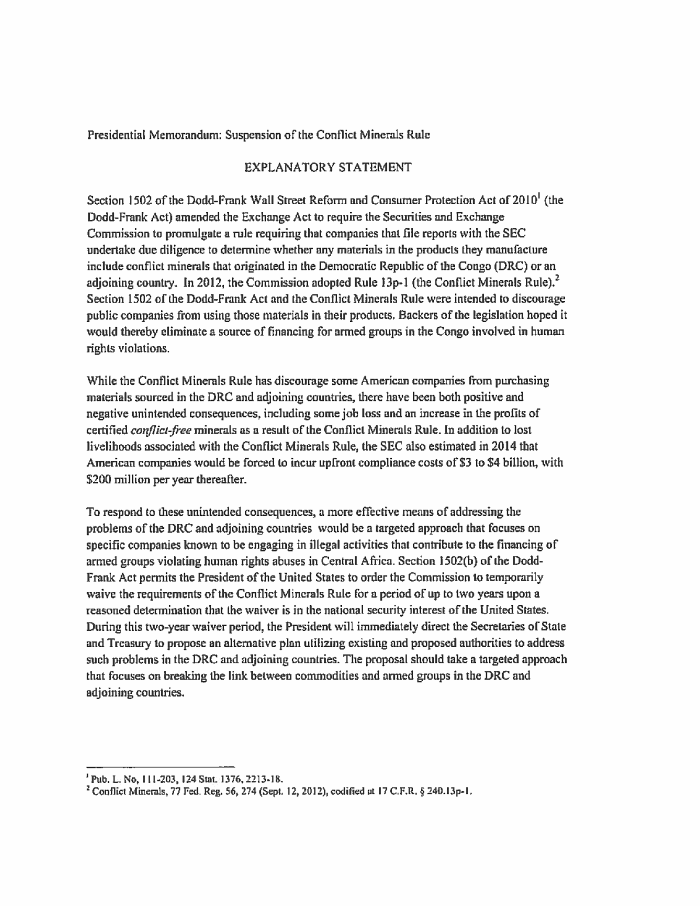
THE LEAKED DRAFT of a presidential memorandum Donald Trump is expected to sign within days suspends a 2010 rule that discouraged American companies from funding conflict and human rights abuses in the Democratic Republic of Congo through their purchase of “conflict minerals.”
The memo, distributed inside the administration on Friday afternoon and obtained by The Intercept, directs the Securities and Exchange Commission to temporarily waive the requirements of the Conflict Mineral Rule, a provision of the Dodd Frank Act, for two years — which the rule explicitly allows the president to do for national security purposes. The memorandum also directs the State Department and Treasury Department to find an alternative plan to “address such problems in the DRC and adjoining countries.”
The idea behind the rule, which had bipartisan support, was to drain militias of revenue by forcing firms to conduct reviews of their supply chain to determine if contractors used minerals sourced from the militias.
The impending decision comes as Trump held a meeting Wednesday with Brian Krzanich, the chief executive of Intel, one of the leading firms impacted by conflict mineral regulations. At the White House today, Krzanich appeared with the president to announce a new manufacturing plant in Arizona.
Human rights advocates — who had celebrated the conflicts rule as a major step forward — were appalled. “Any executive action suspending the U.S. conflict minerals rule would be a gift to predatory armed groups seeking to profit from Congo’s minerals as well as a gift to companies wanting to do business with the criminal and the corrupt,” said Carly Oboth, the policy adviser at Global Witness, in a statement responding to a Reuters article that first reported the move.
“It is an abuse of power that the Trump administration is claiming that the law should be suspended through a national security exemption intended for emergency purposes. Suspending this provision could actually undermine U.S. national security.”
Advanced computer chips, including technology used in cell phones and semiconductors, contain minerals often sourced from war-torn countries in central Africa. Firms such as Intel, Apple, HP, and IBM use advanced chips that contain tantalum, gold, tin, and tungsten — elements that can be mined at low prices in the the DRC, where mines are often controlled by militias fueling a decadeslong civil war.
American tech companies, such as Intel, lobbied directly on the rule when it was proposed. But since passage, tech firms have largely used third party business groups to stymie the rule. Trade groups representing major U.S. tech firms and other manufacturers, including the U.S. Chamber of Commerce and the Business Roundtable, attempted to block the rule through a federal lawsuit. In 2014, a federal court struck down a part of the rule that forced firms to reveal DRC conflict minerals on their corporate websites.
Intel is also one of the firms that has touted its effort to comply with the law, publishing a report that notes the company has conducted 40 on-site reviews of smelters in the eastern DRC.
Reuters also reported that acting SEC chief Michael Piwowar has taken steps to also weaken enforcement, asking staff to “reconsider how companies should comply.”
The memo, distributed inside the administration on Friday afternoon and obtained by The Intercept, directs the Securities and Exchange Commission to temporarily waive the requirements of the Conflict Mineral Rule, a provision of the Dodd Frank Act, for two years — which the rule explicitly allows the president to do for national security purposes. The memorandum also directs the State Department and Treasury Department to find an alternative plan to “address such problems in the DRC and adjoining countries.”
The idea behind the rule, which had bipartisan support, was to drain militias of revenue by forcing firms to conduct reviews of their supply chain to determine if contractors used minerals sourced from the militias.
The impending decision comes as Trump held a meeting Wednesday with Brian Krzanich, the chief executive of Intel, one of the leading firms impacted by conflict mineral regulations. At the White House today, Krzanich appeared with the president to announce a new manufacturing plant in Arizona.
Human rights advocates — who had celebrated the conflicts rule as a major step forward — were appalled. “Any executive action suspending the U.S. conflict minerals rule would be a gift to predatory armed groups seeking to profit from Congo’s minerals as well as a gift to companies wanting to do business with the criminal and the corrupt,” said Carly Oboth, the policy adviser at Global Witness, in a statement responding to a Reuters article that first reported the move.
“It is an abuse of power that the Trump administration is claiming that the law should be suspended through a national security exemption intended for emergency purposes. Suspending this provision could actually undermine U.S. national security.”
Advanced computer chips, including technology used in cell phones and semiconductors, contain minerals often sourced from war-torn countries in central Africa. Firms such as Intel, Apple, HP, and IBM use advanced chips that contain tantalum, gold, tin, and tungsten — elements that can be mined at low prices in the the DRC, where mines are often controlled by militias fueling a decadeslong civil war.
American tech companies, such as Intel, lobbied directly on the rule when it was proposed. But since passage, tech firms have largely used third party business groups to stymie the rule. Trade groups representing major U.S. tech firms and other manufacturers, including the U.S. Chamber of Commerce and the Business Roundtable, attempted to block the rule through a federal lawsuit. In 2014, a federal court struck down a part of the rule that forced firms to reveal DRC conflict minerals on their corporate websites.
Intel is also one of the firms that has touted its effort to comply with the law, publishing a report that notes the company has conducted 40 on-site reviews of smelters in the eastern DRC.
Reuters also reported that acting SEC chief Michael Piwowar has taken steps to also weaken enforcement, asking staff to “reconsider how companies should comply.”
Members of Rochdale child sex grooming gang facing deportation to Pakistan
Four members of the Rochdale child sex abuse gang are facing deportation after losing an appeal to remain in the UK.
Ringleader Shabir Ahmed and Adil Khan, Qari Abdul Rauf and Abdul Aziz were among nine gang members jailed in 2012 for grooming girls as young as 13 with drink and drugs.
They had challenged Government moves to strip them of their British citizenship.
But on Thursday, the Upper Tribunal of the Immigration and Asylum Chamber rejected their appeal.
It means the four men, all originally from Pakistan, could be removed from the UK - though the legal battle is expected to take some time.
Rochdale MP Simon Danczuk has called for the men to be deported to Pakistan "as soon as possible".
He said: "We welcome many people coming to the UK, to contribute, but if they break the law then they should lose their right to live here.
"Foreign-born criminals should not be able to hide behind human rights laws to avoid deportation."
Ahmed, who is serving a 22-year jail sentence for offences including rape, wrote a letter to the European Court Of Human Rights last year claiming his convictions were a conspiracy to "scapegoat" Muslims.
Handing down today's judgment, Mr Justice McCloskey, said the cases were "of some notoriety", and described the men's crimes as "shocking, brutal and repulsive".
He dismissed claims concerning human rights and arguments by three of the men that the Government had failed in a duty to safeguard and promote the welfare of their children.
The judge also rejected a ground of appeal that the Home Office action amounted to a "disproportionate interference" with the men's rights as EU citizens.
The latest ruling does not mean the end of the matter, as the four men can apply for permission to appeal against the tribunal's decision.
Applications can only be made on a question of law, and permission is granted in less than 10% of cases.
While Ahmed remains in custody, the other three have been released on licence.
Khan, Rauf and Aziz were convicted of conspiracy and trafficking for sexual exploitation charges.
They had challenged Government moves to strip them of their British citizenship.
But on Thursday, the Upper Tribunal of the Immigration and Asylum Chamber rejected their appeal.
It means the four men, all originally from Pakistan, could be removed from the UK - though the legal battle is expected to take some time.
Rochdale MP Simon Danczuk has called for the men to be deported to Pakistan "as soon as possible".
He said: "We welcome many people coming to the UK, to contribute, but if they break the law then they should lose their right to live here.
"Foreign-born criminals should not be able to hide behind human rights laws to avoid deportation."
Ahmed, who is serving a 22-year jail sentence for offences including rape, wrote a letter to the European Court Of Human Rights last year claiming his convictions were a conspiracy to "scapegoat" Muslims.
Handing down today's judgment, Mr Justice McCloskey, said the cases were "of some notoriety", and described the men's crimes as "shocking, brutal and repulsive".
He dismissed claims concerning human rights and arguments by three of the men that the Government had failed in a duty to safeguard and promote the welfare of their children.
The judge also rejected a ground of appeal that the Home Office action amounted to a "disproportionate interference" with the men's rights as EU citizens.
The latest ruling does not mean the end of the matter, as the four men can apply for permission to appeal against the tribunal's decision.
Applications can only be made on a question of law, and permission is granted in less than 10% of cases.
While Ahmed remains in custody, the other three have been released on licence.
Khan, Rauf and Aziz were convicted of conspiracy and trafficking for sexual exploitation charges.
Donald Trump's Supreme Court pick hits out at President
Donald Trump's nominee to the Supreme Court has slammed the President's attacks on the judiciary saying they were "disheartening and demoralising".
Judge Neil Gorsuch, who was nominated by Mr Trump to the nation's highest court last week, made his comments after the President accused the appeal court considering his immigration ban of being "so political".
Mr Trump also hit out at district court judge James Robart's original decision to block his executive order to ban residents of seven Muslim-majority countries from entering the US.
He described Mr Robart as a "so-called judge" and referred to his ruling as "ridiculous".
In a series of tweets, the President said: "The opinion of this so-called judge, which essentially takes law-enforcement away from our country, is ridiculous and will be overturned!
"What is our country coming to when a judge can halt a Homeland Security travel ban and anyone, even with bad intentions, can come into US?
"Because the ban was lifted by a judge, many very bad and dangerous people may be pouring into our country. A terrible decision."
Mr Gorsuch hit out at Mr Trump during a meeting with Connecticut Democratic Senator Richard Blumenthal.
Mr Blumenthal, a former state attorney general, said Mr Gorsuch described the President's comments about the judiciary as "demoralising and disheartening".
He said he had told the judge he would need to condemn Mr Trump's attacks on judicial independence publicly.
"It needs to be a strong condemnation and that kind of public condemnation is important to establish his independence," Mr Blumenthal said. "Otherwise, the American public will conclude that he is more likely to be a rubber stamp."
Mr Trump told a group of police chiefs that the ban was "done for the security of our nation".
He quoted text from immigration law that he said gave him the power to enact the order, calling it "beautifully written" and "a bad high school student would understand this".
He went on: "Courts seem to be so political and it would be so great for our justice system if they would be able to read a statement and do what's right.
"And that has to do with the security of our country, which is so important."
The President has repeatedly said people are "pouring in" since the ban was put on hold and suggested that blocking the order would be dangerous for US citizens.
On Wednesday morning he tweeted, "Big increase in traffic into our country from certain areas, while our people are far more vulnerable, as we wait for what should be EASY D!"
The administration has not provided any information to support his claims.
Meanwhile, the US Senate confirmed Jeff Sessions as Attorney General on Wednesday, despite fierce debate about his civil rights record and Democratic concern over whether he is independent from the President.
Judge Neil Gorsuch, who was nominated by Mr Trump to the nation's highest court last week, made his comments after the President accused the appeal court considering his immigration ban of being "so political".
Mr Trump also hit out at district court judge James Robart's original decision to block his executive order to ban residents of seven Muslim-majority countries from entering the US.
He described Mr Robart as a "so-called judge" and referred to his ruling as "ridiculous".
In a series of tweets, the President said: "The opinion of this so-called judge, which essentially takes law-enforcement away from our country, is ridiculous and will be overturned!
"What is our country coming to when a judge can halt a Homeland Security travel ban and anyone, even with bad intentions, can come into US?
"Because the ban was lifted by a judge, many very bad and dangerous people may be pouring into our country. A terrible decision."
Mr Gorsuch hit out at Mr Trump during a meeting with Connecticut Democratic Senator Richard Blumenthal.
Mr Blumenthal, a former state attorney general, said Mr Gorsuch described the President's comments about the judiciary as "demoralising and disheartening".
He said he had told the judge he would need to condemn Mr Trump's attacks on judicial independence publicly.
"It needs to be a strong condemnation and that kind of public condemnation is important to establish his independence," Mr Blumenthal said. "Otherwise, the American public will conclude that he is more likely to be a rubber stamp."
Mr Trump told a group of police chiefs that the ban was "done for the security of our nation".
He quoted text from immigration law that he said gave him the power to enact the order, calling it "beautifully written" and "a bad high school student would understand this".
He went on: "Courts seem to be so political and it would be so great for our justice system if they would be able to read a statement and do what's right.
"And that has to do with the security of our country, which is so important."
The President has repeatedly said people are "pouring in" since the ban was put on hold and suggested that blocking the order would be dangerous for US citizens.
On Wednesday morning he tweeted, "Big increase in traffic into our country from certain areas, while our people are far more vulnerable, as we wait for what should be EASY D!"
The administration has not provided any information to support his claims.
Meanwhile, the US Senate confirmed Jeff Sessions as Attorney General on Wednesday, despite fierce debate about his civil rights record and Democratic concern over whether he is independent from the President.
Wednesday, February 8, 2017
NHS crisis: Public back tax rises to boost healthcare - poll
More than two-thirds of the public would back an increase in income tax if the money was dedicated to the NHS, according to a poll for Sky News.
The survey by Sky Data shows 68% would support a 1% rise in income tax if the Government guaranteed to spend it on healthcare.
The results also reveal that 64% of people believe the service provided by the NHS is getting worse - and 57% expect it to deteriorate further in future.
The NHS is currently under unprecedented pressure.
Hospitals have not met their A&E targets for several months because they have been overwhelmed by patients.
Sky News spent a day in Milton Keynes University Hospital to see how the pressure is affecting care.
The staff are doing their utmost to ensure patients get safe care. However, they concede that it is still not to the standard they would like.
Mandy Knight, head of nursing in the A&E unit, said: "We all came in to nursing to look after patients and do the best we can for them.
"But when you are in a full Emergency Department you can't always do that - because you're busy."
Hospitals across the country have seen demand for care soar in recent weeks.
Since Christmas, dozens of hospitals have declared "black alerts" - signalling the extraordinary pressure they are under.
Milton Keynes hospital has a 28-bed unit dedicated to routine surgery. But at times this winter almost half of the beds have had to be prioritised for emergency patients.
It has meant patients have had planned operations cancelled at the last minute.
Kathriona McCann, the divisional manager of surgery, said the unit has to juggle patients.
"Every one of them has their own story of why they need that surgery," she said.
"It is never easy to make those decisions. Some of them have been waiting quite a few weeks and some of them months."
Like all hospitals, Milton Keynes is being squeezed by the lack of care beds elsewhere in the system.
Georgette Newell, 86, was well enough to be discharged 12 days ago. But the rehabilitation unit she has been referred to has no space for her, so she occupies a hospital bed she does not really need.
"It must be very upsetting for people who need the bed space. I feel guilty," she said.
The survey by Sky Data shows 68% would support a 1% rise in income tax if the Government guaranteed to spend it on healthcare.
The results also reveal that 64% of people believe the service provided by the NHS is getting worse - and 57% expect it to deteriorate further in future.
The NHS is currently under unprecedented pressure.
Hospitals have not met their A&E targets for several months because they have been overwhelmed by patients.
Sky News spent a day in Milton Keynes University Hospital to see how the pressure is affecting care.
The staff are doing their utmost to ensure patients get safe care. However, they concede that it is still not to the standard they would like.
Mandy Knight, head of nursing in the A&E unit, said: "We all came in to nursing to look after patients and do the best we can for them.
"But when you are in a full Emergency Department you can't always do that - because you're busy."
Hospitals across the country have seen demand for care soar in recent weeks.
Since Christmas, dozens of hospitals have declared "black alerts" - signalling the extraordinary pressure they are under.
Milton Keynes hospital has a 28-bed unit dedicated to routine surgery. But at times this winter almost half of the beds have had to be prioritised for emergency patients.
It has meant patients have had planned operations cancelled at the last minute.
Kathriona McCann, the divisional manager of surgery, said the unit has to juggle patients.
"Every one of them has their own story of why they need that surgery," she said.
"It is never easy to make those decisions. Some of them have been waiting quite a few weeks and some of them months."
Like all hospitals, Milton Keynes is being squeezed by the lack of care beds elsewhere in the system.
Georgette Newell, 86, was well enough to be discharged 12 days ago. But the rehabilitation unit she has been referred to has no space for her, so she occupies a hospital bed she does not really need.
"It must be very upsetting for people who need the bed space. I feel guilty," she said.
Incredibly high radiation levels discovered at crippled Fukushima plant
Newly-discovered radiation levels in one of the Fukushima Daiichi Nuclear Power Plant’s reactors are stunningly high, the Japan Times and others have reported. The space is so radioactive that even a robot couldn’t last two hours, let alone a human.
It was on March 11, 2011, that the coastal power plant in Japan’s Fukushima Prefecture was hit by a tidal wave, which not only cut off the plant’s electrical power, also took out the generators that provided its backup power. The natural disaster triggered the meltdown of three reactors at the plant.
The new readings come from inside reactor two, where the radiation levels are 530 sieverts per hour, according to Tepco, the Tokyo Electric Power Company. That’s highly radioactive— most radiation is measured in thousandths of a sievert, a unit called a millisievert.
One dental X-ray is just .01 millisievert, according to the Guardian— which also pointed out that 10 sieverts can lead to death.
BY SQUEEZING AND TWISTING, NEW ROBOT COULD KEEP HEARTS PUMPING
At the end of January, Tepco said that they had taken, from inside reaction two, “intriguing images that may be fuel debris from the March 2011 accident,” but needed to study them more. (They have provided more information of their findings in this PDF.)
The company would like to deploy a robot, but the robot would be fried before even two hours at those radiation levels, since it is designed to endure 1000 sieverts, according to the Japan Times.
The radiation levels are the highest yet measured at the devastated plant, which could take as many as four decades to fully deal with.
MEET THE 'BAT BOT': SCIENTISTS UNVEIL ROBOT THAT FLIES JUST LIKE A BAT
Not since Chernobyl suffered a catastrophic meltdown in 1986 in the former Soviet Union has the world witnessed such a serious nuclear accident— and it was only in 2016 that experts succeeded in covering Chernobyl’s site with a large protective dome to protect the concrete sarcophagus.
It was on March 11, 2011, that the coastal power plant in Japan’s Fukushima Prefecture was hit by a tidal wave, which not only cut off the plant’s electrical power, also took out the generators that provided its backup power. The natural disaster triggered the meltdown of three reactors at the plant.
The new readings come from inside reactor two, where the radiation levels are 530 sieverts per hour, according to Tepco, the Tokyo Electric Power Company. That’s highly radioactive— most radiation is measured in thousandths of a sievert, a unit called a millisievert.
One dental X-ray is just .01 millisievert, according to the Guardian— which also pointed out that 10 sieverts can lead to death.
BY SQUEEZING AND TWISTING, NEW ROBOT COULD KEEP HEARTS PUMPING
At the end of January, Tepco said that they had taken, from inside reaction two, “intriguing images that may be fuel debris from the March 2011 accident,” but needed to study them more. (They have provided more information of their findings in this PDF.)
The company would like to deploy a robot, but the robot would be fried before even two hours at those radiation levels, since it is designed to endure 1000 sieverts, according to the Japan Times.
The radiation levels are the highest yet measured at the devastated plant, which could take as many as four decades to fully deal with.
MEET THE 'BAT BOT': SCIENTISTS UNVEIL ROBOT THAT FLIES JUST LIKE A BAT
Not since Chernobyl suffered a catastrophic meltdown in 1986 in the former Soviet Union has the world witnessed such a serious nuclear accident— and it was only in 2016 that experts succeeded in covering Chernobyl’s site with a large protective dome to protect the concrete sarcophagus.
Subscribe to:
Comments (Atom)